

CNC machining lead time is one of the most critical concerns for engineers, procurement teams, and project managers. Whether you are developing a prototype or scaling to production, understanding how long CNC machining really takes can significantly impact project timelines, costs, and supply chain planning.
This guide breaks down CNC machining lead time from a real manufacturing perspective—explaining what affects lead time, typical timelines for different scenarios, and how to realistically shorten it in 2026.
What Is CNC Machining Lead Time?
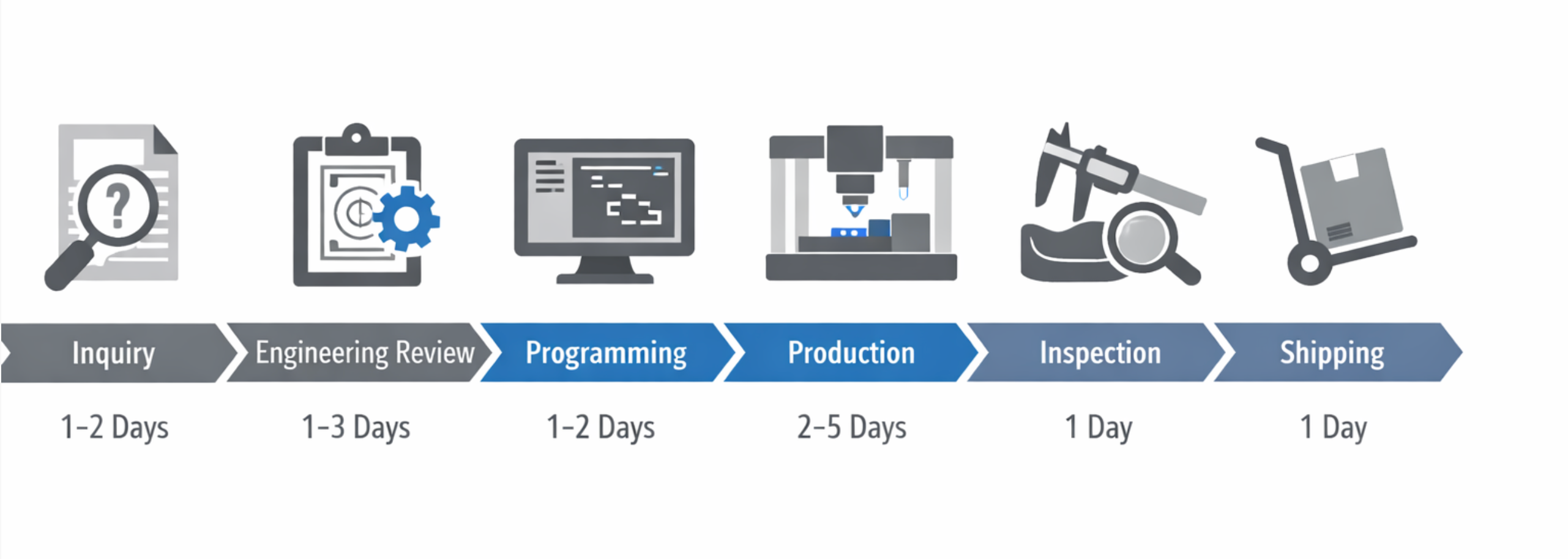
CNC machining lead time refers to the total time required from order confirmation to finished part delivery. It typically includes:
- Quotation and engineering review
- CAM programming and setup
- Material sourcing
- Machining and secondary operations
- Inspection and quality control
- Packaging and shipping
Lead time is not just machining time—it reflects the entire manufacturing workflow.
Typical CNC Machining Lead Time in 2026
Prototype CNC Parts
- Simple parts: 3–5 business days
- Medium complexity: 5–7 business days
- High precision or complex geometry: 7–10+ business days
Low-Volume Production (10–100 pcs)
- Standard parts: 7–14 days
- Multi-axis or tight tolerance parts: 10–20 days
Medium to High-Volume Production (100+ pcs)
- Initial batch including setup: 2–4 weeks
- Repeat orders: significantly faster once setup is established
These are realistic industry averages—not guarantees—because lead time depends on several key variables.
Key Factors That Affect CNC Machining Lead Time
1. Part Design & Complexity
Complex features such as deep pockets, thin walls, undercuts, and free-form surfaces increase machining time and often require multiple setups.
2. Tolerance Requirements
Tighter tolerances demand slower cutting speeds, more stable fixturing, and additional inspection steps—all of which extend lead time.
3. Material Availability
Common materials like Aluminum 6061 are usually in stock, while specialty alloys or certified materials may require additional sourcing time.
4. Machine Type & Capacity
3-axis machines are widely available, while 5-axis machines are often in higher demand. Advanced machines can reduce setups but may increase queue time.
5. Setup & Programming Time
For prototypes, setup and CAM programming can represent a large portion of total lead time.
6. Secondary Processes
Surface finishing, heat treatment, or coating processes often add days or weeks depending on availability and batch scheduling.
Prototype vs Production Lead Time
Prototype lead time is usually longer per part due to:
- One-time programming and setup
- Engineering validation
- Manual inspection
Production runs benefit from optimized tooling, standardized processes, and reduced per-part cycle time.
How to Reduce CNC Machining Lead Time
Apply DFM Early
Design for Manufacturability helps eliminate unnecessary complexity and reduces rework.
Use Standard Materials
Choosing readily available materials avoids procurement delays.
Avoid Over-Tight Tolerances
Only specify tight tolerances where functionally necessary.
Batch Orders Strategically
Larger batches help amortize setup time and improve scheduling efficiency.
Communicate Clearly
Providing clear drawings, 3D models, and revision control prevents delays caused by clarification loops.
CNC Machining Lead Time vs Other Manufacturing Methods
Compared to casting or injection molding, CNC machining offers:
- No mold lead time
- Faster design changes
- Higher precision
For low to medium volumes, CNC machining remains one of the fastest manufacturing options.
Conclusion
So, how long does CNC machining really take in 2026?
The answer depends on design complexity, material choice, tolerance requirements, production volume, and process planning—not just machine speed.
By understanding these factors, engineers and procurement teams can set realistic expectations, reduce delays, and build more resilient supply chains.
Post time: Jan-28-2026


